Clocks Turn Back Sunday as Halloween and Daylight Saving End Align
The time change coincides with the holiday this year, a rare occurrence that will not happen again until 2036.
By Hana Gray ·
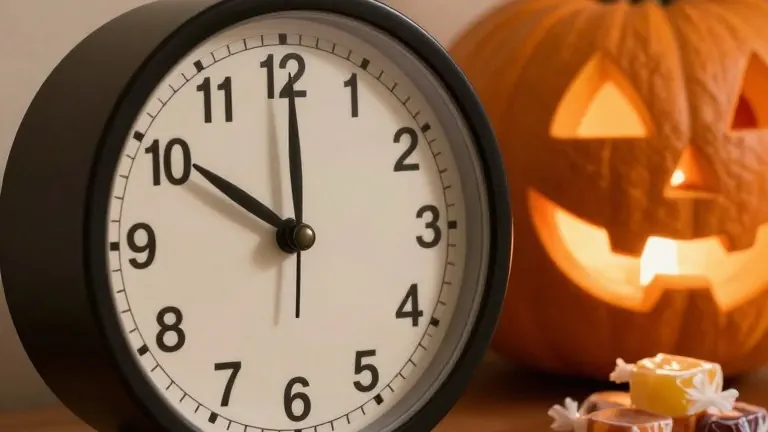
American households will gain an extra hour of sleep on Sunday, November 1, when clocks are set back from 2 a.m. to 1 a.m. local time. This action marks the official end of daylight saving time. The date aligns with Halloween, a calendar overlap that will not occur again until 2036.
Daylight saving time operates on a fixed schedule established in 1966. It begins on the second Sunday of March, when clocks move forward one hour. It concludes on the first Sunday of November, when clocks move back. President Lyndon B. Johnson signed the Uniform Time Act in 1966 to standardize these changes. Before that law, local governments set their own schedules, causing time discrepancies between cities like Boston and Washington, D.C.
The practice has evolved over the last century. The U.S. first enacted daylight saving time in 1918 to conserve fuel and provide more evening sunlight. It was repealed after World War I, reinstated during World War II, and repealed again. In 2005, President George W. Bush extended the period by four weeks through an energy bill. Since 2007, the current schedule has remained in place.
Two states, Hawaii and Arizona, do not observe the time change. The Navajo Indian Reservation in Arizona is the exception. U.S. territories including Puerto Rico, Guam, American Samoa, and the U.S. Virgin Islands also remain on standard time year-round.
Legislative efforts to end the biannual switch continue in Washington. In July, the House of Representatives voted 308 to 117 to pass the Sunshine Protection Act. The bill would allow states to make daylight saving time permanent if they choose. President Donald Trump supported the measure, citing benefits for tourism and outdoor recreation. Critics raised concerns about potential negative health impacts. The House Energy and Commerce Committee had passed the measure 48 to 1 in May after the president urged Congress to push for more evening daylight.
The bill is currently stalled in the Senate. It requires approval from both chambers before it can be signed into law. A previous attempt to end the time change in the 1970s lasted less than a year due to public backlash. Health experts note that the time shift affects circadian rhythms. Studies link the spring forward change to spikes in fatal car accidents, heart attacks, and strokes. The fall change often affects individuals with seasonal affective disorder, a type of depression linked to shorter days.
The next time change will occur on the second Sunday of March 2027, when clocks will spring forward again.
Source: KNSD