69 Studies Confirm: Tennis Players Blame Outside Forces for 10,515 Losses
New research validates the local amateur practice of filing defensive alibis before the first serve, a habit shared by top pros from Nadal to McEnroe.
By Aisha Saeed ·
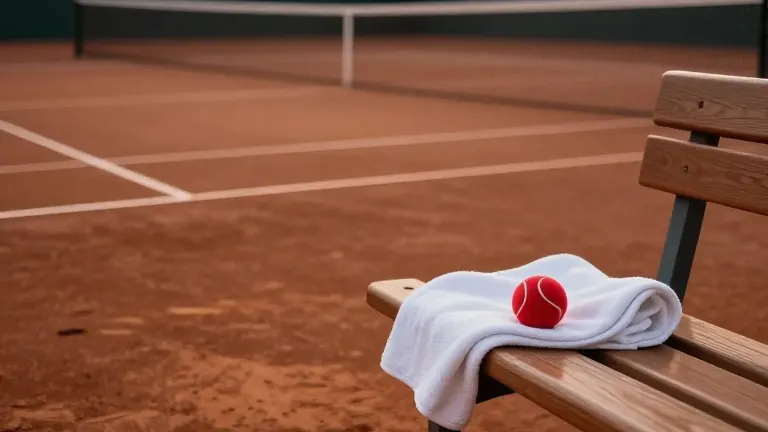
A new analysis of 69 studies covering 10,515 athletes confirms that players consistently attribute victories to their own skill while assigning losses to external factors. This finding validates the behavior of amateur tennis players in Longboat Key, Florida, who often construct detailed excuses before a match begins. The research indicates that athletes take credit for wins and hand their losses to outside forces, a pattern that is particularly strong in individual sports.
The study provides a statistical basis for the "defensive pessimism" observed on local courts. Players frequently cite physical ailments, equipment failures, or weather conditions to lower expectations before playing. A psychologist at Wellesley College, Julie Norem, notes that these individuals perform worse when encouraged to picture success. Instead, they use lowered expectations to tune their performance. This strategy allows players to play loose and free, while positioning their opponents as favorites.
The practice is not limited to local clubs. Rafael Nadal demonstrated this technique at the 2011 French Open. After beating Ivan Ljubicic in straight sets, Nadal told reporters he was not playing well enough to win the tournament. He then won the event, defeating Roger Federer in the final. This sequence of a pre-match alibi followed by a heroic victory is a common pattern in professional tennis. Nadal later admitted to using the same tactic after a loss in Rome in 2020, stating he simply had not played well enough.
Equipment issues also serve as frequent justifications. In 2012, the Madrid Open switched to blue clay to improve television visibility. Rafael Nadal lost to Fernando Verdasco and blamed the surface, saying it would not let him move. He threatened to skip future tournaments on the surface. Novak Djokovic was also eliminated, having previously suggested he needed football shoes or a consultant to cope. Tournament owner Ion Tiriac apologized for the slippery courts. The ATP banned blue clay the following year.
Physical ailments, particularly shoulder issues, are a staple of post-match explanations. In 2016, Nick Kyrgios lost to Mischa Zverev in Shanghai and cited a sore arm. Later that day, he stated he could not find an excuse. John McEnroe, who went 82 and 3 in 1984, lost the French Open final after being distracted by noise from a cameraman's headset. Three years later, the tournament director in Rome allegedly paid a maintenance man to cut the stadium lights twice to help McEnroe recover from a struggling start. McEnroe won in three sets.
The Sarasota Open, an ATP Challenger event, has historically taken place in the region. From 2009 through 2014, it was played on the green clay at the Longboat Key Club's Tennis Gardens. Kei Nishikori won the event in 2010, and James Blake won in 2011. The tournament has since moved to various locations, including Lakewood Ranch, Laurel Oak, Payne Park, and the Sarasota Sports Club. In April 2026, Wu Yibing won the event at IMG Academy in Bradenton. Coach Patrick Mouratoglou observes that pros who lose often insist they are perfectly healthy, implying they are not.
Local participation in tennis remains high despite the prevalence of excuses. A 2021 report from a local paper noted that more than 200 members at the Bird Key Yacht Club played tennis on three Har-Tru courts. The club's tennis director estimated that a thriving club needs about 25 members per court. With 200 members and three courts, the ratio is roughly 67 players per court. This high density of players creates frequent opportunities for the pre-match alibi and the post-match explanation to unfold.
Source: Longboat Key News