Grid Credits: UK Drafts £4,000 Incentive for Bidirectional EV Tech
The proposal would allow manufacturers to offset petrol sales with credits for installing vehicle-to-grid systems, a move criticized by industry groups as a subsidy for hardware over usage.
By Hana Gray ·
The UK government has opened a consultation to grant carmakers financial credits for electric vehicles equipped with vehicle-to-grid technology. The proposal, part of a review of the zero-emission vehicle mandate, aims to provide manufacturers with a monetary incentive to install bidirectional charging systems in new cars. Under the draft rules, each car fitted with this technology would generate a credit valued at approximately £4,000.
These credits would allow manufacturers to sell additional petrol models without facing penalties for missing emission targets. The mechanism effectively turns a piece of software and hardware into a tradeable asset that offsets the cost of non-electric vehicle sales. The government closed the consultation period on Friday, seeking feedback on how to structure these incentives within the broader automotive regulatory framework.
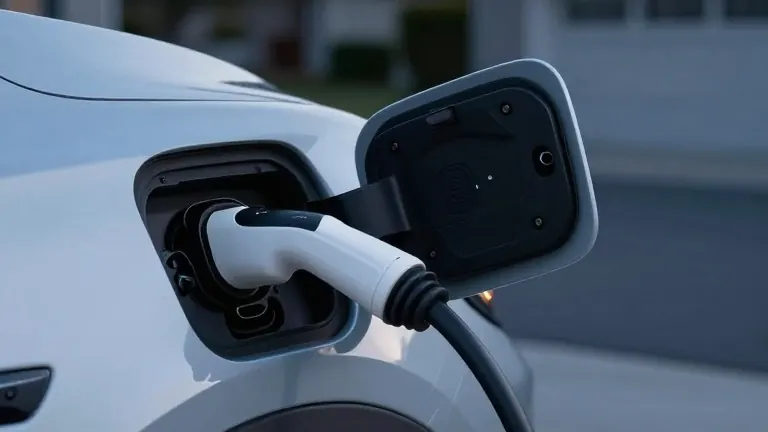
Vehicle-to-grid technology enables cars to discharge stored electricity back into the national grid. Drivers charge their vehicles during off-peak hours when electricity costs are low, and the system automatically sells power back during periods of high demand. This process helps balance the grid, reducing the need for gas power plants to fill supply gaps when wind and solar generation drops. The technology also supports home energy management by allowing cars to power household appliances.
Ben Nelmes, chief executive of the thinktank New AutoMotive, argued that the current proposal rewards installation rather than active use. He noted that the hardware cost is relatively low compared to the value of the credit. "Under these proposals, one or even two extra credits worth around £4,000 each would hand manufacturers thousands per car for kit that costs a few hundred pounds, even though few drivers own the expensive charger needed to use it," Nelmes said. He urged ministers to ensure that drivers and billpayers, rather than shareholders, receive the primary financial benefit.
The Electric Vehicle Association England raised concerns about the timing of the incentive. Vicky Edmonds, the group's chief executive, stated that while millions of drivers own electric vehicles, only a small fraction currently use storage or grid-exporting features. "It is far too early to be giving manufacturers a credit that effectively allows them to sell fewer EVs, for a technology that has not even been tried and tested, at scale, by drivers in the real world," Edmonds said. She highlighted that consumers are still focused on vehicle costs and daily utility.
The proposal coincides with preparations to lower electric vehicle sales targets under the existing mandate. Environmental groups anticipate that these changes could lead to an additional 147 million tonnes of carbon emissions by 2050 if the pace of electrification slows. The government aims to spread the adoption of grid-supporting technology to alleviate strain on the electricity network and reduce reliance on expensive fossil fuel generation during peak hours.
Some drivers already participate in grid-export schemes through providers like Octopus Energy in the UK, Renault in France, and BMW in Germany. Octopus Energy has estimated that participants can save approximately £620 annually through these services. The new government credits would expand this model by attaching a regulatory value to the technology itself, potentially accelerating its inclusion in standard vehicle configurations.
The National Energy System Operator forecasts that if vehicle-to-grid adoption reaches its projected scale, the technology could provide 1.2 gigawatts of on-demand power by 2030. That capacity is equivalent to the output of a large power station. The operator projects the potential to grow to 41 gigawatts by 2050, which would be sufficient to meet more than a quarter of the country's peak energy demand.
Source: The Guardian
More Business · Consumer Alerts · Report a business · Got a Story?