Moon Water Reserves Constrain City Scale
Harvard physicists calculate that lunar water stocks could sustain a million residents for only a century, forcing a rethink of settlement plans.
By Hana Gray ·
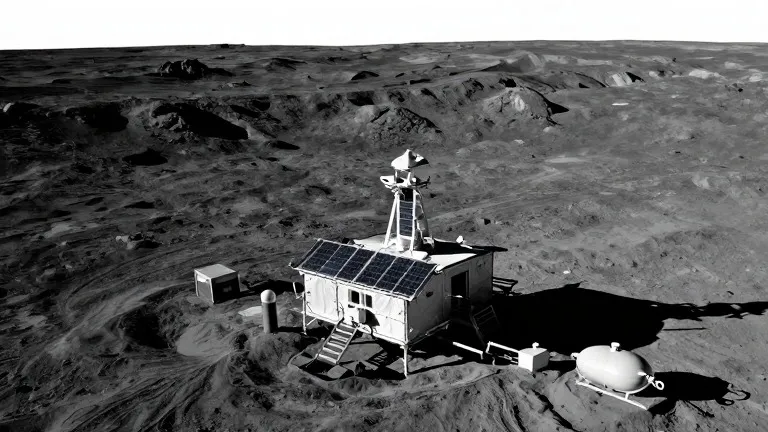
A new study published in Frontiers in Space Technologies argues that the moon lacks enough accessible water to support the massive cities envisioned by major tech leaders. The analysis by Harvard astrophysicist Martin Elvis and Durham University professor Jonathan McDowell focuses on the physical limits of lunar habitability. They conclude that while power generation is solvable, water scarcity is the primary bottleneck for large-scale settlement.
The researchers tested claims made by industry executives against available geological data. In February, SpaceX CEO Elon Musk stated the company is building a self-growing city on the moon, a process he estimated would take under 10 years. Blue Origin CEO Jeff Bezos has predicted that millions of people will live in space by 2045. Elvis and McDowell examined whether these projections align with the known quantity of lunar resources.
The pair found that solar and nuclear power could easily supply one million people. The constraint lies in water, which is primarily located in permanently shadowed polar regions. Current estimates place the total available water at roughly one billion tonnes. Under the assumption that 98 percent of this water is recycled, as is done on the International Space Station, a population of one million would exhaust the supply in about 100 years.
Elvis compared the total water volume to a small lake, noting it would not supply a big city for long. He described the reservoir as resembling an aquarium the size of Central Park filled until the Statue of Liberty is just underwater. A settlement of 10,000 people, however, could be sustainable for centuries under the same recycling assumptions. McDowell stated that covering the moon with cities requires finding a way to transport water to the surface because it is not currently there in accessible forms.
The study's baseline figures may be optimistic. Elvis suggested the one billion tonne estimate is likely 20 or 30 times too high. He further noted that only one-third to one-half of the water would be recoverable. His best estimate is that the usable amount is about one percent of the original figure, which would reduce the lifespan for a million residents from 100 years to just one year.
Gordon Osinski, a planetary geology professor at Western University, noted that satellite measurements carry uncertainties. He believes the water exists but requires ground confirmation. He suggested the water might resemble Arctic permafrost, consisting of sub-millimetre ice crystals mixed into soil that are difficult to extract. McDowell said the findings should encourage exploration rather than discourage it, arguing that negative thinking only occurs when trying to do something that will not work.
Source: CBC News